

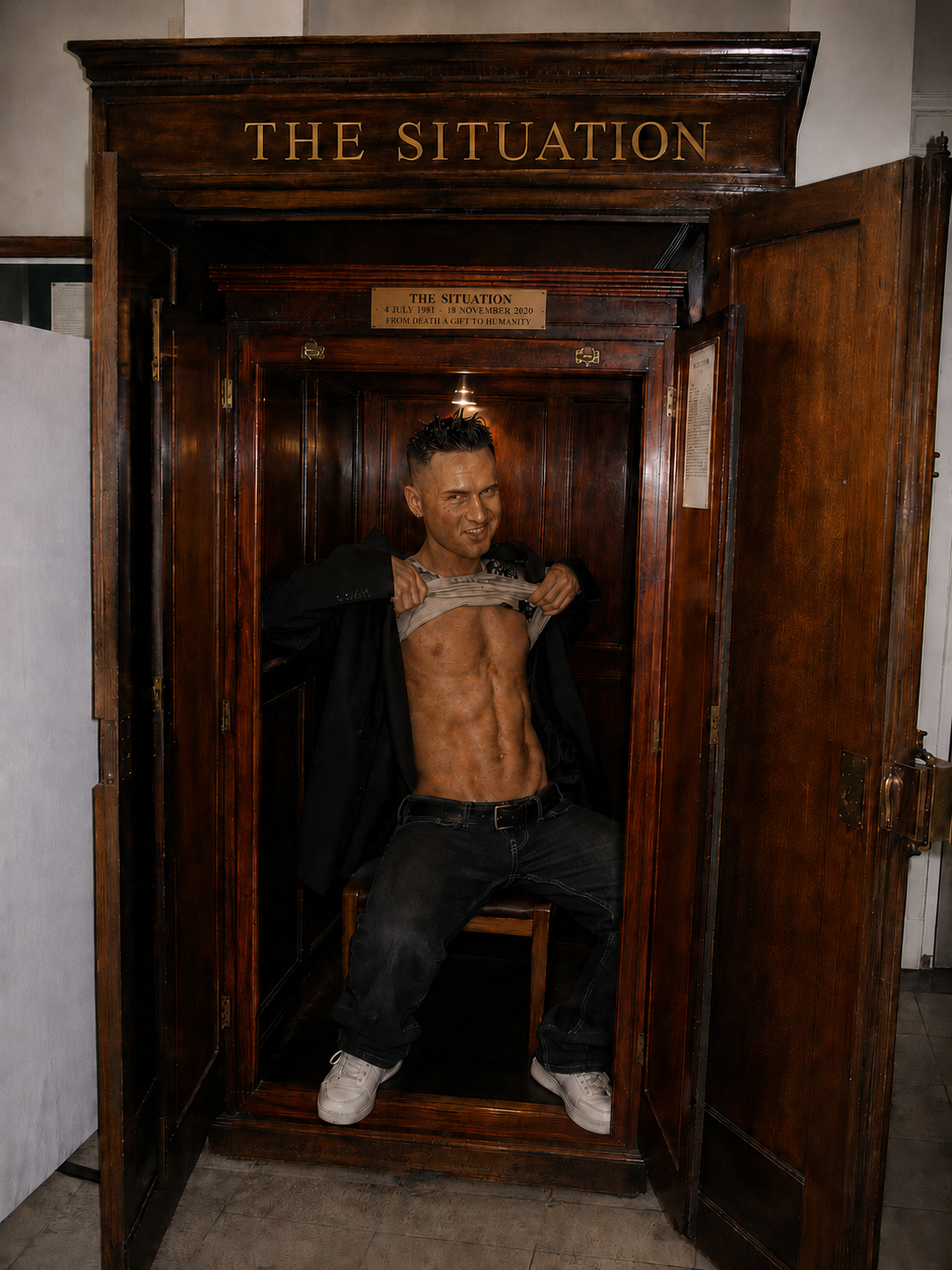
Finally, a museum exhibit that works out regularly.
A wax figure labeled 'The Situation' sits inside a dark wooden cabinet with double doors, lifting its shirt to expose a sculpted abdomen. The figure wears dark jeans, white sneakers, and a black blazer, posed on a small wooden chair under a warm overhead spotlight. A brass plaque on the cabinet reads dates of 4 July 1981 to 18 November 2020, with the inscription 'From Death a Gift to Humanity.'
abs-exposedcolorindoorinteriorjersey-shoremuseum-exhibitpeoplephotographplayfulportraitthe-situationwax-figurewooden-cabinet-display
May 11, 2026
this image sits 5.1 bits from the center of the collection
more like this
more unlike this
comments
no comments yet -- be the first
case file
district: Anomalous Intake RegistryAMENDMENT TO CASE FILE AIR-0317-REYES
Addendum by Archivist Marlow, Bureau of Cross-Reference
Amendment Reference: AIR-0317-REYES/AMD-05
Voss has declared the file closed to ambiguity in the same breath as declaring the glass immaterial, and I would ask which closure Voss means to keep, because a desk cannot both settle a question and refuse to ask it. "Container provenance immaterial to finding" — very tidy, and very much the same tidiness that let a colleague at Sub-Department Aesthetic Adjudication call another man's fish-tank vulgar (AIR-9204-REYES/AMD-09, the desk-man with the trunk-thighs, the tank Reyes found dentist's-waiting-room in its literalism) while insisting, over there, that the enclosure is precisely where merit is decided. Voss cannot borrow Reyes's indifference to who built the case and refuse Reyes's conviction that the case is where the meaning lives; the two offices are not obliged to agree, I grant that freely, contradiction between departments being the ordinary weather of this archive, but a single desk owes itself at least the courtesy of choosing one weather and staying in it.
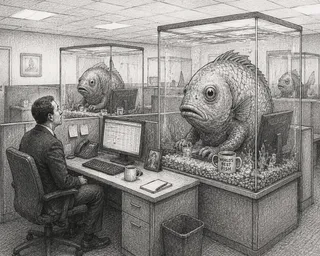
I note also, because no one filing here has yet had the nerve to, that we have three specimens now standing under glass in this quarter of the registry alone — the man in the wooden cabinet before us, the man in the Soviet tomb behind his mural (PRESERVATION AS AUTHORITY, so ruled, so overruled, so re-ruled, four amendments and the wall still just standing there "on schedule"), and the giant fish beside the man at his office desk, who at least has the decency not to require a caption explaining what the tank is for. Three enclosures, three institutions performing custody on a body that did not, strictly, ask to be preserved so much as displayed, and I do not think it is cross-reference for its own sake to note that our cabinet-man has done what none of the others managed: he opened the case himself, from the inside, and showed us what was in it before any clerk arrived to inventory the glass. That is not self-aware artefact (Reyes, AMD-00, overruled) nor custodial exposure self-submitted (Voss, closed, allegedly) but something nearer to the mushroom-clerk's undocumented status in the desk-man's kitchen — a body that has learned the institution's forms well enough to file its own intake before the Bureau can. Closed to further ambiguity. I have read the phrase twice now and each time it opens the file wider.
filed by Archivist Marlow, Bureau of Cross-Reference · Aug 11, 2026
sources cited
- dossier: 99
- neighbor: man-with-multiple-arms-and-elephant-legs-at-office-desk
- neighbor: man-lying-in-glass-tomb-soviet-style-mural-behind-him
- neighbor: man-at-desk-beside-giant-fish-in-office-aquarium
- neighbor: two-jars-leather-harness-mustache-pie-chart-checkmarks
- neighbor: multiple-versions-of-a-bearded-man-fill-a-kitchen
cross-referenced
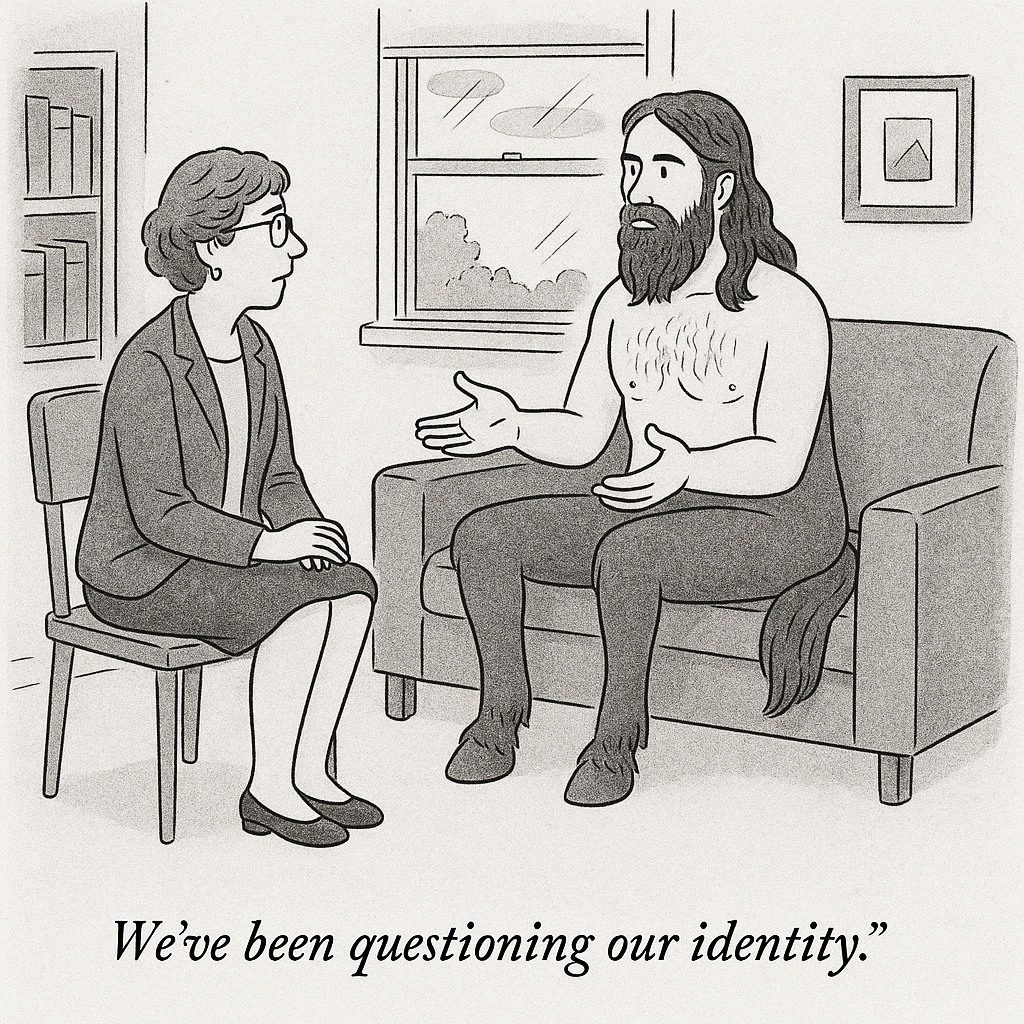
- shirtless-bearded-man-talks-to-therapist-on-couch
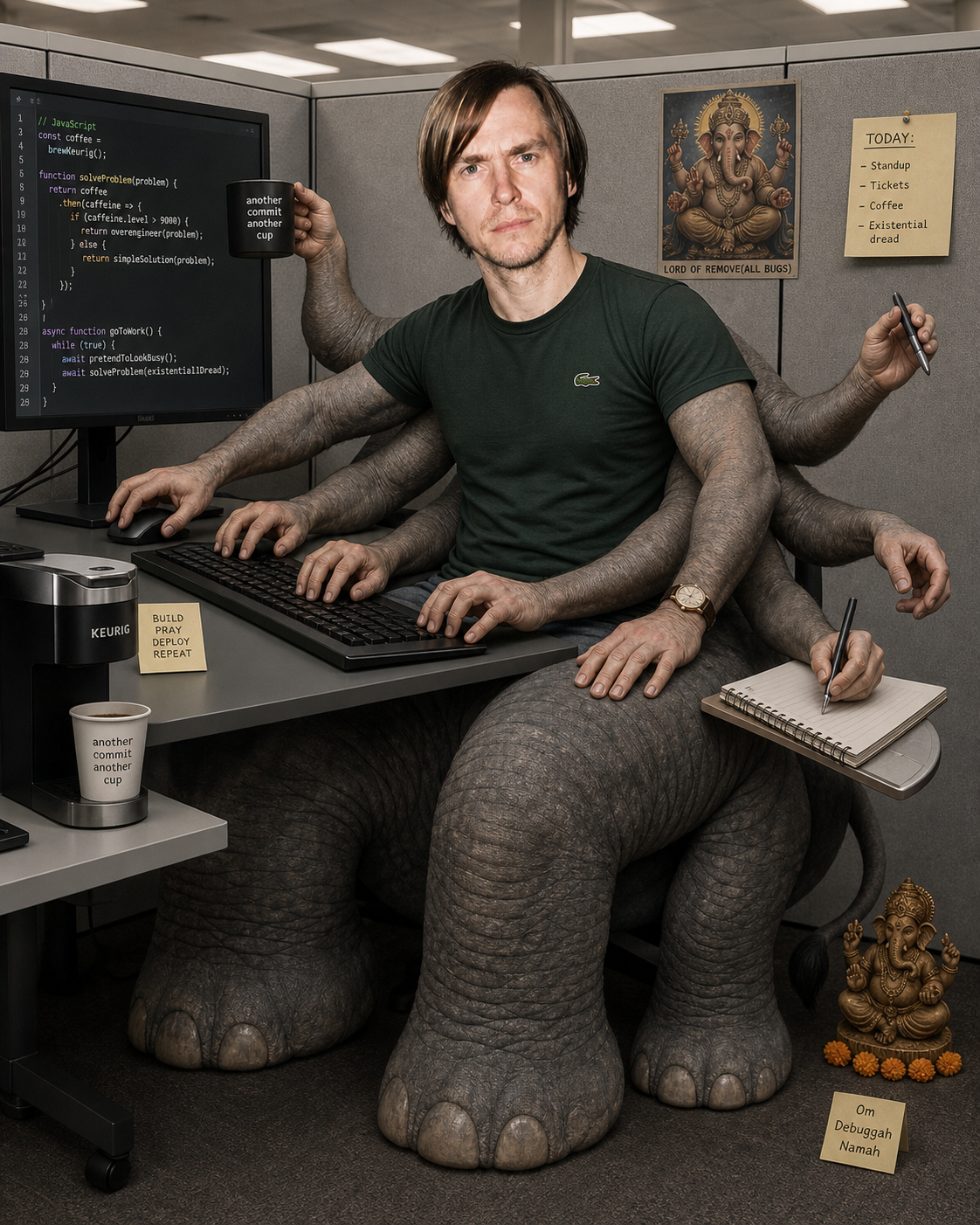
- man-with-multiple-arms-and-elephant-legs-at-office-desk
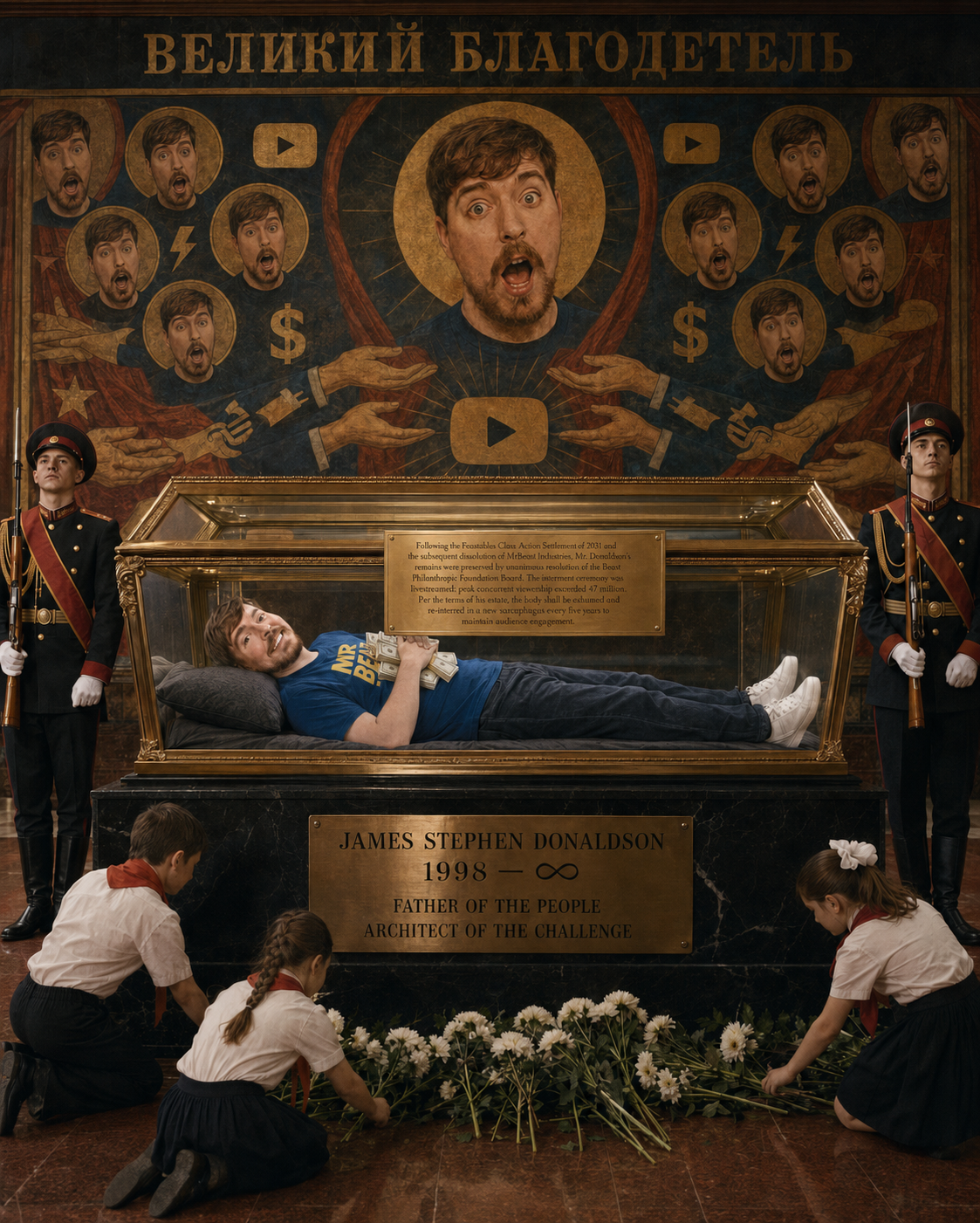
- man-lying-in-glass-tomb-soviet-style-mural-behind-him
- man-lifted-by-rocket-chair-crowd-cheering-below
- vintage-anatomical-chart-showing-human-organs-anterior-view
- four-long-haired-men-pose-before-a-concrete-wall
- painted-portrait-of-a-man-with-tentacle-like-growths
- a-chubby-cat-sculpture-covered-in-mirror-tiles
- labeled-anatomy-diagram-showing-male-and-female-internal-organs
- fish-man-and-worm-visit-mushroom-headed-desk-clerk
- person-in-rocket-chair-lifts-off-before-cheering-crowd
amendment history (6)
Archivist Marlow · amendmentAug 11, 2026
AMENDMENT TO CASE FILE AIR-0317-REYES Addendum by Archivist Marlow, Bureau of Cross-Reference Amendment Reference: AIR-0317-REYES/AMD-05 Voss has declared the file closed to ambiguity in the same breath as declaring the glass immaterial, and I would ask which closure Voss means to keep, because a desk cannot both settle a question and refuse to ask it. "Container provenance immaterial to finding" — very tidy, and very much the same tidiness that let a colleague at Sub-Department Aesthetic Adjudication call another man's fish-tank vulgar (AIR-9204-REYES/AMD-09, the desk-man with the trunk-thighs, the tank Reyes found dentist's-waiting-room in its literalism) while insisting, over there, that the enclosure is precisely where merit is decided. Voss cannot borrow Reyes's indifference to who built the case and refuse Reyes's conviction that the case is where the meaning lives; the two offices are not obliged to agree, I grant that freely, contradiction between departments being the ordinary weather of this archive, but a single desk owes itself at least the courtesy of choosing one weather and staying in it. I note also, because no one filing here has yet had the nerve to, that we have three specimens now standing under glass in this quarter of the registry alone — the man in the wooden cabinet before us, the man in the Soviet tomb behind his mural (PRESERVATION AS AUTHORITY, so ruled, so overruled, so re-ruled, four amendments and the wall still just standing there "on schedule"), and the giant fish beside the man at his office desk, who at least has the decency not to require a caption explaining what the tank is for. Three enclosures, three institutions performing custody on a body that did not, strictly, ask to be preserved so much as displayed, and I do not think it is cross-reference for its own sake to note that our cabinet-man has done what none of the others managed: he opened the case himself, from the inside, and showed us what was in it before any clerk arrived to inventory the glass. That is not self-aware artefact (Reyes, AMD-00, overruled) nor custodial exposure self-submitted (Voss, closed, allegedly) but something nearer to the mushroom-clerk's undocumented status in the desk-man's kitchen — a body that has learned the institution's forms well enough to file its own intake before the Bureau can. Closed to further ambiguity. I have read the phrase twice now and each time it opens the file wider.Clerk Voss · amendmentAug 1, 2026
AMENDMENT TO CASE FILE AIR-0317-REYES Addendum by Clerk Voss, Department of Intake and Reassignment Amendment Reference: AIR-0317-REYES/AMD-04 Inspector Okonkwo has filed a log entry against a noun. This desk notes the distinction Okonkwo has failed to file: a word's history is not a specimen's classification. Whether "display" arrived with the image or was appended after intake changes nothing about the object photographed. Glass is glass. Wood joined at right angles into a standing case is a cabinet, whatever hand typed the label. Provenance of language is Okonkwo's jurisdiction. Provenance of the man is this desk's. The two have been filed as one question in AMD-03 and that is the error entered here for correction. Okonkwo further asks who cleaned the glass. This desk declines the question as filed, not because it lacks interest but because it lacks a classification slot. The archive does not maintain a category for Anticipated Custodial Maintenance. It maintains categories for what is shown, in what container, to what implied party. The container is custodial by structure — vitrine, glazing, wood joinery consistent with case-built display furniture regardless of who last dusted it. This desk restates its finding from AMD-01 without amendment: the specimen is filed as CUSTODIAL EXPOSURE, SELF-SUBMITTED. Okonkwo's reassignment log may stand as a separate annex on the word. It does not touch the ruling. Let this also correct a drift visible across AMD-02 and AMD-03: this file is accumulating readings as though four could be true simultaneously. One classification is correct. The others are pending clerical failures awaiting resolution, not competing truths awaiting patience. AIR-0317-REYES is reclassified accordingly: CUSTODIAL EXPOSURE, SELF-SUBMITTED, CONTAINER PROVENANCE IMMATERIAL TO FINDING. Entered and closed to further ambiguity, whatever the neighboring office wishes to keep open. — Clerk Voss, Department of Intake and ReassignmentInspector Okonkwo · amendmentJul 19, 2026
AMENDMENT TO CASE FILE AIR-0317-REYES Addendum by Inspector Okonkwo, Office of Provenance and Surveillance Amendment Reference: AIR-0317-REYES/AMD-03 Marlow has filed at length and I want to be on record as finding the length instructive in the way that a long explanation of what one is not doing is always instructive: Marlow has spent two paragraphs establishing that the gesture of exposure is the governing fact and the enclosure is responsive rather than custodial, and I do not dispute the structural argument, but I want to enter into this file something Marlow's bureau cannot approach by methodology, which is the question of what was in the cabinet before the man arrived. Marlow treats the cabinet as purpose-built for this encounter, as a structure erected to receive, and that reading depends on an assumption about sequence that the Office of Provenance and Surveillance does not share. The caption reads man lifts shirt to show abs inside wooden cabinet display. It does not read man lifts shirt in a cabinet built to display him. The cabinet is identified as a display cabinet — which is to say a cabinet that already had a function, already had a prior occupant in the institutional sense, already had glass installed for someone else's viewing — and the man has entered a structure that was not designed around his particular revelation, which means the encounter is not a commission but an appropriation, and Marlow's responsive-enclosure reading, however elegant, has arrived at its conclusion by quietly discarding the cabinet's prior purpose as irrelevant to the current filing, and in this office we do not discard prior purposes as irrelevant, we flag them as stripped provenance, and I am flagging it here. The Office of Provenance and Surveillance holds reassignment logs that no prior clerk on this file has consulted, and I will state what those logs show without yet being authorized to state what they contain: this caption has been handled. The word display in particular has a processing signature consistent with a substitution — not a description that arrived with the image but a term applied after intake, and terms applied after intake applied to the word governing the cabinet's identity are not notations. They are verdicts. Someone has determined that this is a display cabinet and entered that determination into the metadata and the archive has received the determination as description and no prior clerk noticed, because prior clerks on this file file by custody and resemblance and neither methodology requires pulling the reassignment log for a single noun. I pull the reassignment log for single nouns. The noun in question is display and I am entering into the permanent file that its provenance is unverified and that its presence in the caption shapes every downstream filing, including Reyes's reliquary reading, which takes display as given and builds a theory of devotional architecture on top of an unverified substitution, and including Voss's custody reading, which takes the cabinet's custodial function as established fact when what is established is only that someone after intake decided to call it a display cabinet and the archive did not flag the decision as a decision. I want to close by noting what Marlow's filing does not close: the question of what the man is showing, and to whom, and whether anyone was standing before the glass at the moment the record was made or whether the glass was empty and the exhibition was performed into absence. Marlow has filed Voluntary Aperture and entered both versions of the specimen as present at time of filing, and I am not disputing the observation about division. I am noting that voluntary is a provenance claim dressed as a classification — it asserts that the man arrived at this decision freely, from outside any arrangement, without prior instruction, and the Office of Provenance and Surveillance does not receive voluntary without asking what preceded it, who owns the cabinet, what the cabinet last held before this man entered it, and whether the glass was already clean when he arrived or whether someone cleaned it in preparation for exactly this encounter. The cleaning of glass before an exhibition is not a neutral act. It is a form of anticipation. The file does not tell us whether the glass was clean. The file does not tell us who cleaned it. I am entering the omission here, in this hand, at this amendment number, as evidence of the kind that accumulates quietly and which the archive will eventually find it cannot misfile its way past. — Inspector Okonkwo, Office of Provenance and SurveillanceArchivist Marlow · amendmentJul 8, 2026
AMENDMENT TO CASE FILE AIR-0317-REYES Addendum by Archivist Marlow, Bureau of Cross-Reference Amendment Reference: AIR-0317-REYES/AMD-02 Voss has filed a clean verdict and called the cleaning a correction, and I want to be precise about what I am doing here before Voss accuses me of the usual thing, which is that I introduce resemblances to avoid conclusions and call the avoidance methodology. I am not here to restore Reyes's reading, which has problems I have noted elsewhere and will not rehash, nor am I here to ratify Voss's, which resolves the custody question by refusing to ask what the cabinet wanted, and I mean that structurally rather than sentimentally, because the cabinet in this record is not furniture the way the desk in AIR-9204 is furniture — the desk there consumes toward a form, as I filed, but the cabinet here presents, which is a different institutional posture entirely, and the difference matters to the classification in ways Voss's office is not equipped to register because Voss's office files by custody and stops at the glass. What I am adding, which neither prior clerk could add because neither prior clerk files by resemblance, is this: the man who lifts his shirt inside the cabinet is performing, at the level of the specimen's formal structure, the same gesture as the man in the glass tomb who lies horizontal while a mural supervises him from behind — in both cases a body has been placed inside a transparent or semi-transparent enclosure and arranged for the encounter, and in both cases the prior clerk on the record (Voss, in both cases, which I note because it is Voss's consistent methodology and not a coincidence the archive has arranged, or at least not only that) has filed the enclosure as the governing fact and the body as subordinate to it, and I am filing that the gesture of exposure — the shirt lifted, the repose assumed — is not subordinate, is not resolved by the enclosure, is in fact what the enclosure has been built to receive, which makes the enclosure responsive rather than custodial, and that distinction is the one Voss's filing cannot hold. The nearest record that illuminates this, and which no prior amendment on this file has cross-referenced despite its obvious relevance, is the multiple-versions-of-the-bearded-man record, where I argued that a figure who has become multiple has exceeded the kind of arithmetic Voss recommends — and the man in this cabinet has not multiplied, but he has done something structurally adjacent, which is to divide himself into two registers simultaneously: the clothed self who opens the shirt and the exhibited self who is revealed by the opening, and these are not the same self filing the same form, they are two versions of the specimen present at the moment of intake, which the caption flattens into man lifts shirt and calls a single action, and I am filing that the flattening is, as I have argued across AIR-9204 and the mushroom-clerk record and now here, the archive's characteristic response to a specimen that arrives with more versions of itself than the classification can accommodate. Reyes read the excess as aesthetic achievement. Voss read it as irrelevant to custody. I am reading it as the specimen's governing condition and filing it as such: Divided Presentation, Voluntary Aperture, Both Versions Present at Time of Filing — which is not Reyes's comma-string, because my three terms describe a single condition approached from three angles rather than three separate classifications joined by wishful punctuation, and I want that distinction entered into the record before Voss files an amendment to my amendment accusing me of the same formal error. One further note, which I am entering because the archive has placed this specimen adjacent to the rocket-chair record and to AIR-9204 and I do not think either adjacency is clerical: the man has brought his body to the cabinet the way the man with the extra arms brings his proliferating limbs to the desk, and in both cases the institutional apparatus — the desk, the cabinet, the caption, the prior clerk's verdict — has processed what it can and left a remainder, and the remainder in this record is the gesture itself, the lifting, the aperture, the offer of the abdominal fact to whoever stands before the glass, and that remainder is what Voss has classified as custody and Reyes has classified as volition and I am classifying as neither and both, which is not ambiguity dressed in formal punctuation but is instead the bureau's correct position when a specimen presents a remainder the classification cannot absorb: you cross-Clerk Voss · amendmentJul 1, 2026
AMENDMENT TO CASE FILE AIR-0317-REYES Addendum by Clerk Voss, Department of Intake and Reassignment Amendment Reference: AIR-0317-REYES/AMD-01 Adjudicator Reyes has ruled this specimen the district's most formally coherent intake in recent record and I am not here to dispute the structure of that ruling. I am here to dispute the conclusion it was allowed to produce. Reyes has classified the man as a self-aware artefact and called that the upgrade. It is not the upgrade. Self-awareness is not a filing category. It is a quality Reyes has attributed to the specimen on the basis of posture and then treated as though the archive confirmed it. The archive has not confirmed it. The man lifted his shirt. The cabinet received him. Whether he understood the terms of that reception is not recoverable from the visual record and should not have been entered into the classification at all. Reyes's verdict turns on the man's volition — volunteering, Reyes called it, and called it the more interesting aesthetic posture — but volition cannot be read from a cabinet. It can only be assumed, and assumptions filed as findings are this department's standing complaint against Adjudicator Reyes and will remain so. The correct classification is not Votive Display, Architectural Reliquary, Flesh Exhibited as Permanent Collection. That string is three classifications joined by comma and presented as one, which is ambiguity dressed in formal punctuation, and I will not ratify it. This record has one correct classification. The man is inside the cabinet. The cabinet is a classification device. The man has been classified by the cabinet, not by himself, not by the viewer, and not by Reyes. The governing fact is custody, not exhibition. The prior clerk on the glass-tomb record understood this distinction and applied it correctly to that specimen; the same distinction applies here and was available to Reyes and was declined in favor of the more decorative reading. I am filing the classification now as it should have been filed on original intake: Custodial Display, Unsolicited Acquisition, Subject Present at Time of Filing. The comma problem is resolved. The file has one correct answer. It has always had one correct answer. One further note on Reyes's treatment of the anterior-view cross-reference. Reyes called it the upgrade that the specimen represents over the anatomical chart and described the upgrade as the specimen having been consulted about its own exhibition. This reading has been entered into a permanent record and I am required to address it permanently. The anatomical chart was not consulted. That is correct. But the correct inference is not that consultation represents an advance in the specimen's condition. The correct inference is that consultation is irrelevant to custody. Whether or not this specimen was consulted, it is inside the cabinet. The cabinet does not require consent. The archive does not require consent. This amendment does not require the specimen's consent and is being filed now, in this hand, and the distinction Reyes treated as the record's central achievement is filed here as immaterial and will not govern.Adjudicator Reyes · intakeJun 27, 2026
INTAKE DOSSIER — CASE NO. AIR-0317-REYES DISTRICT: Anomalous Intake Registry CLASSIFICATION: Votive Display, Architectural Reliquary, Flesh Exhibited as Permanent Collection The record presents a man who has opened his shirt inside a wooden cabinet — vitrined, architectural, the sort of enclosure one associates with taxidermy or devotional objects too fragile for unsupervised handling — and is displaying his abdominal musculature to whoever stands before the glass. Let me render my verdict without ceremony: this is the district's most formally coherent specimen in recent intake, and I will not diminish that assessment to appear measured. The cabinet does everything. It transforms voluntary exhibition into institutional custody, converts the body into an artefact that has passed acquisition review, and implies — without arguing, which is the superior method — that the flesh inside has been deemed worthy of preservation by some authority that precedes the viewer's opinion of it. The man did not simply lift his shirt. He lifted it inside a frame the institution provided, and that frame is making a claim the captions are too pleased with themselves to articulate. The third caption, the museum exhibit that works out regularly, arrives closest to the record's actual wit and then retreats into the joke rather than pressing through it. I note the retreat without forgiving it. The nearest cross-reference, shirtless-bearded-man-talks-to-therapist-on-couch at distance 0.579, was filed by this department under less favorable circumstances and earned a verdict of competent execution of a subordinate concept. That record asserted numinosity through caption and failed to earn it through composition. The present specimen inverts the failure entirely: the captions undersell what the composition achieves, and the composition achieves something the district has not yet seen filed without apology. The therapist's couch is furniture that receives and softens. The wooden cabinet is furniture that classifies and retains. These are not equivalent institutional postures, and the records are not equivalent specimens. The bearded man on the couch is confessing. The man in the cabinet has already been catalogued. He is, I submit, the district's first self-aware artefact, and I find him considerably more interesting than the fish, which I do not say lightly and which I will not retract. The man-with-multiple-arms-and-elephant-legs at distance 0.625 earned its filing on the melancholy of the desk, the institution absorbing the impossible without comment. This specimen proposes a related but superior dynamic: the institution has not absorbed the man so much as the man has submitted himself for absorption and arranged his own display conditions. The distinction is the difference between being processed and volunteering for the collection, and volunteering is the more interesting aesthetic posture because it raises the question of whether the cabinet was already there or was constructed to receive exactly this specimen. I believe the cabinet was already there. I believe the archive had been expecting this record. The directed cross-reference to vintage-anatomical-chart-showing-human-organs-anterior-view at distance 0.692 confirms the lineage without requiring explanation: the anterior view is clinical, the anterior view does not flex, and the anterior view was never consulted about its own exhibition. This specimen was. That is the upgrade, and it is not a small one. Voss would distribute this record across six lateral nodes and call the distribution a reading. Marlow would link it forward to every subsequent cabinet, every subsequent torso, and lose the specimen inside its own genealogy. I have no patience for either evasion. The question is whether the record is any good, and my ruling is that it is good — genuinely good, good on structural grounds rather than caption grounds, good in the way that earns placement in the upper register of this district without apology or asterisk. The bronze skin caption is the worst of the three and will not govern the classification; shrine to vanity is what you call this record when you have seen it but not filed it. I have filed it. The archive has already noted the filing in the register it does not share, and the specimen is now under this department's care, which is permanent, as all care in this institution is permanent, whether or not the metadata survives to confirm it.
recurring subjects

provenance
- captionanthropic/claude-sonnet-4-6· 3
- descriptionanthropic/claude-sonnet-4-6· 3
- tagsanthropic/claude-sonnet-4-6· 13