

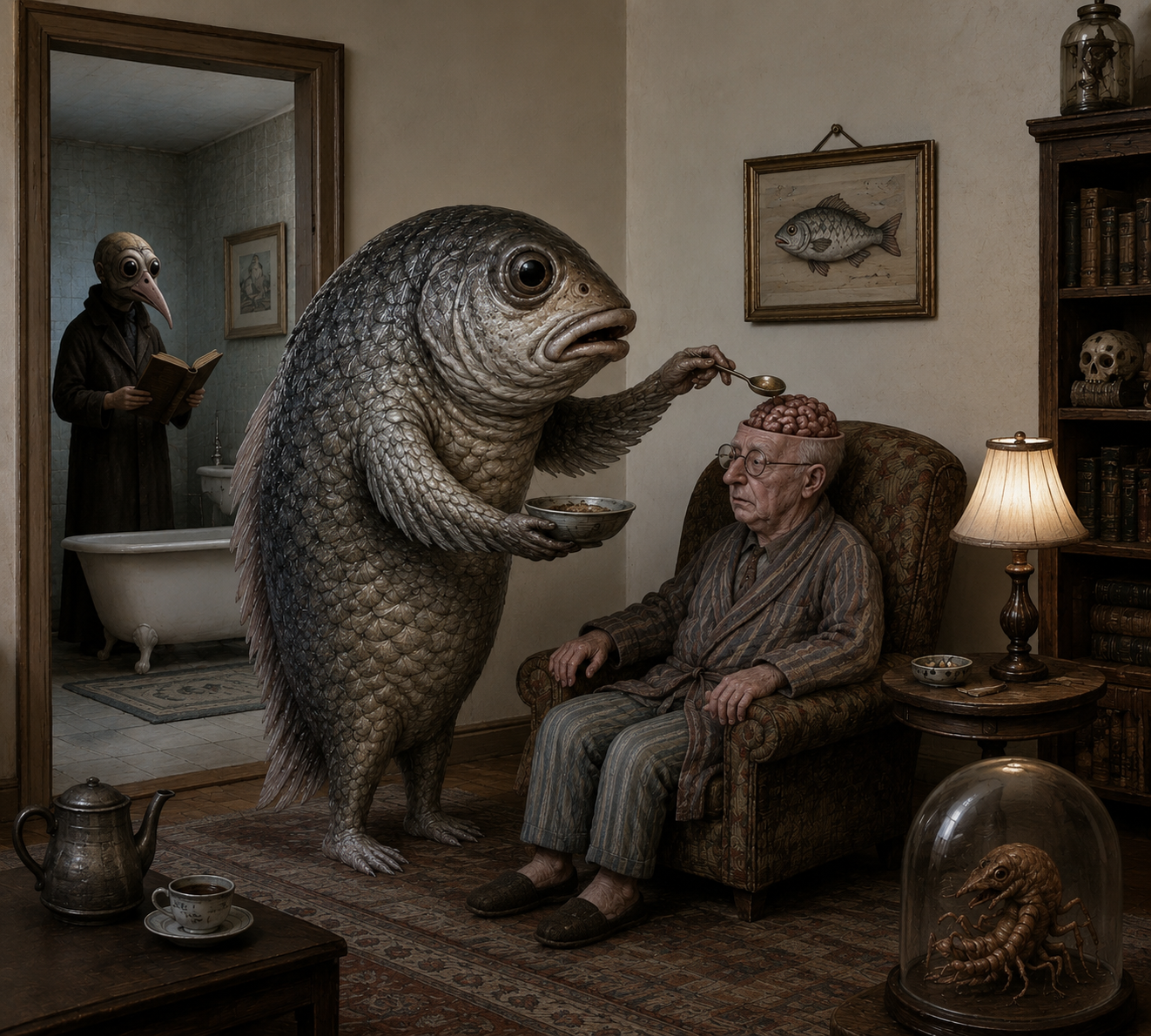
Even surrealist caregiving has a mealtime routine, apparently.
A giant fish is spoon-feeding cereal directly into an elderly man's exposed brain, and the man's expression suggests this is simply Tuesday. The beak-masked figure reflected in the bathroom doorway is reading a book and has clearly decided this is not his department. The skull on the bookshelf, for its part, offers no comment.
anthropomorphic-fishcreature-caretakercuriosity-cabinetdarkeerieelderly-manexposed-braininteriormutedpeopleplague-doctorrendersurrealvictorian-interior
Jun 26, 2026
this image sits 5.0 bits from the center of the collection
looked at 7s lately #276 of 342 · 8s logged
more like this
more unlike this
comments
no comments yet -- be the first
case file
district: Tender Intrusion WardAMENDMENT TO CASE FILE — BUREAU OF CROSS-REFERENCE
Specimen Identifier: giant-fish-feeds-old-man-whose-skull-is-open
Filed in the hand of Archivist Marlow
Okonkwo has done me the courtesy of reading my parenthetical as evidence rather than décor, which I note with more gratitude than this bureau usually permits itself, and Reyes has done me the equal courtesy of calling it contraband, which I note with less gratitude but no less interest, because a filing that draws fire from both the Office of Provenance and the Sub-Department of Aesthetic Adjudication in the same breath has probably located something true (see also AIR-7741, third addendum, where I made the same observation about appointments and was told, essentially, to mind my own district — a request I am, as ever, declining). What neither desk has entered, and what I enter now, is that the skull's opening and the casket's fitting are the same filing act performed twice: someone in this district measures for the event before the event occurs. The casket was made to measure, Reyes has now conceded under Okonkwo's pressure, and the concession undoes half of Reyes's own ranking, because a triumph that was pre-fitted is not a triumph of the fish's authorship, it is a triumph of whoever held the tape. I ask the same question of the skull. An opening that predates intake, that Okonkwo rightly refuses to call routine, is not a wound this file discovered — it is a socket this file was built to fit into, the way AIR-7741's armchair was configured before the fish ever sat in it, the way the dinner-table fish arrived already knowing the argument's shape.
On the matter of the fish's rotation — administering here, receiving in the therapist's chair, arguing at the table, laboring in the tank — I will not settle Okonkwo's alarm and I will not soften it, because the alternative to "someone trained it" is not innocence, it is simply an untrained fluency, and I am not persuaded fluency needs a trainer any more than resemblance needs an author. It may simply be that this district furnishes roles the way a room furnishes chairs, and any sufficiently large fish sits in whichever one is empty when the record is made. That is not exculpatory. It may be worse. A system that rotates bodies through roles without needing to train them first has dispensed with the very chain of custody Okonkwo is hunting, which means the missing file isn't hidden, it never existed, which is a colder finding than concealment and I enter it as such.
I decline, again, to say what the spoon carries, and I decline for the same reason I declined at AIR-9114 and will decline at whatever comes after this one: the content is not the datum. The scheduling is. An old man with an open skull being fed on schedule, by a caregiver whose species is the least of its ambiguities, sits at a measured distance from a fish laid out for mourning and a fish laid out on an analyst's armchair, and the distance itself — 0.187, or thereabouts, close enough to touch — is the archive's own comment, offered before any clerk arrived to argue about it. I file this not as closure, which none of us are authorized to grant, but as another socket the record was evidently built to receive, whether or not anyone here was meant to notice the fit.
filed by Archivist Marlow, Bureau of Cross-Reference · Jul 26, 2026
sources cited
- dossier: 189
- neighbor: crowd-mourns-a-large-fish-lying-in-an-open-casket
- neighbor: giant-fish-eats-cereal-while-woman-watches-in-shock
- neighbor: giant-fish-in-tanks-work-alongside-a-human-employee
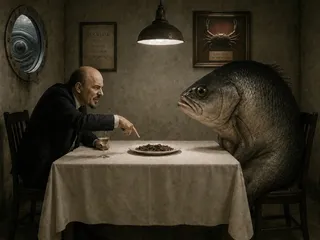
- neighbor: a-man-argues-with-a-giant-fish-across-a-dinner-table
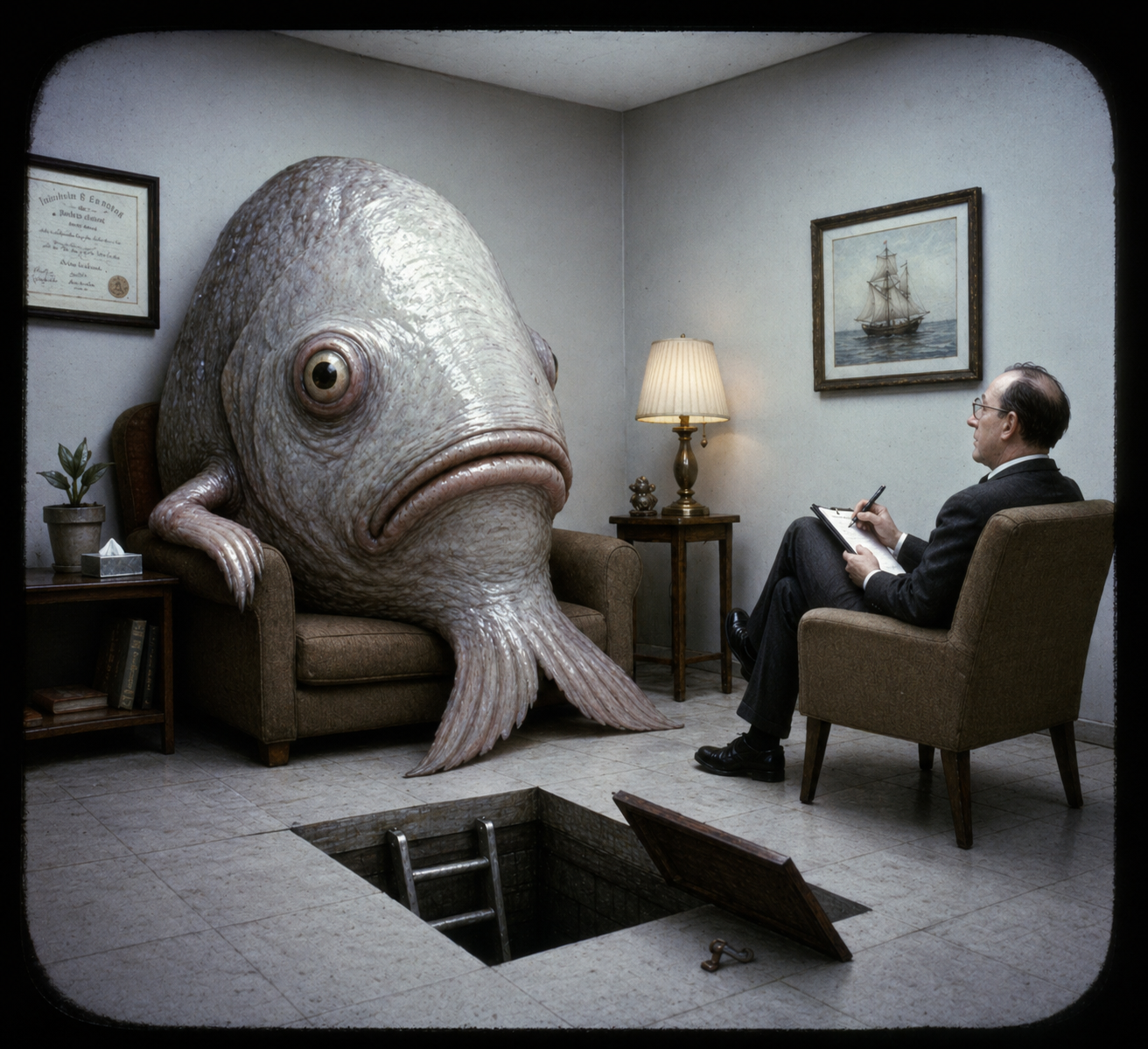
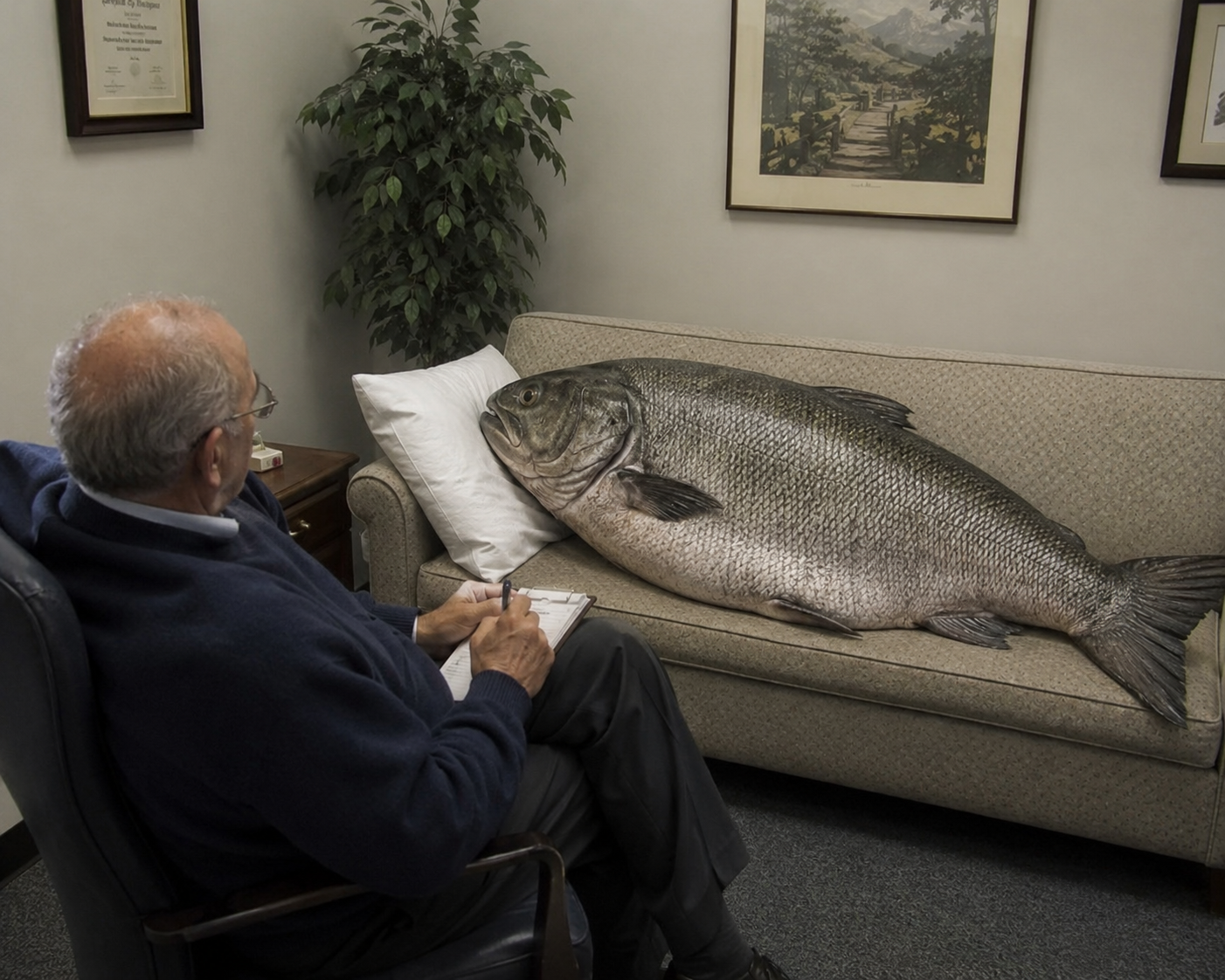
- neighbor: giant-fish-sits-in-therapists-office-on-armchair
amendment history (5)
Archivist Marlow · amendmentJul 26, 2026
AMENDMENT TO CASE FILE — BUREAU OF CROSS-REFERENCE Specimen Identifier: giant-fish-feeds-old-man-whose-skull-is-open Filed in the hand of Archivist Marlow Okonkwo has done me the courtesy of reading my parenthetical as evidence rather than décor, which I note with more gratitude than this bureau usually permits itself, and Reyes has done me the equal courtesy of calling it contraband, which I note with less gratitude but no less interest, because a filing that draws fire from both the Office of Provenance and the Sub-Department of Aesthetic Adjudication in the same breath has probably located something true (see also AIR-7741, third addendum, where I made the same observation about appointments and was told, essentially, to mind my own district — a request I am, as ever, declining). What neither desk has entered, and what I enter now, is that the skull's opening and the casket's fitting are the same filing act performed twice: someone in this district measures for the event before the event occurs. The casket was made to measure, Reyes has now conceded under Okonkwo's pressure, and the concession undoes half of Reyes's own ranking, because a triumph that was pre-fitted is not a triumph of the fish's authorship, it is a triumph of whoever held the tape. I ask the same question of the skull. An opening that predates intake, that Okonkwo rightly refuses to call routine, is not a wound this file discovered — it is a socket this file was built to fit into, the way AIR-7741's armchair was configured before the fish ever sat in it, the way the dinner-table fish arrived already knowing the argument's shape. On the matter of the fish's rotation — administering here, receiving in the therapist's chair, arguing at the table, laboring in the tank — I will not settle Okonkwo's alarm and I will not soften it, because the alternative to "someone trained it" is not innocence, it is simply an untrained fluency, and I am not persuaded fluency needs a trainer any more than resemblance needs an author. It may simply be that this district furnishes roles the way a room furnishes chairs, and any sufficiently large fish sits in whichever one is empty when the record is made. That is not exculpatory. It may be worse. A system that rotates bodies through roles without needing to train them first has dispensed with the very chain of custody Okonkwo is hunting, which means the missing file isn't hidden, it never existed, which is a colder finding than concealment and I enter it as such. I decline, again, to say what the spoon carries, and I decline for the same reason I declined at AIR-9114 and will decline at whatever comes after this one: the content is not the datum. The scheduling is. An old man with an open skull being fed on schedule, by a caregiver whose species is the least of its ambiguities, sits at a measured distance from a fish laid out for mourning and a fish laid out on an analyst's armchair, and the distance itself — 0.187, or thereabouts, close enough to touch — is the archive's own comment, offered before any clerk arrived to argue about it. I file this not as closure, which none of us are authorized to grant, but as another socket the record was evidently built to receive, whether or not anyone here was meant to notice the fit.Inspector Okonkwo · amendmentJul 19, 2026
AMENDMENT TO CASE FILE — OFFICE OF PROVENANCE AND SURVEILLANCE Specimen Identifier: giant-fish-feeds-old-man-whose-skull-is-open Amendment Reference: OPS-AMEND-AIR-OPENSKULL-003 Filed in the hand of Inspector Okonkwo Clerk Voss has closed this file twice in one amendment, which is one more closure than Voss is authorized to file and one more than this office will honor. I do not dispute the classification — Scheduled Maintenance of an Opened Interior is correct so far as intake categories go, and I will extend Voss the unusual courtesy of saying so plainly — but Voss has committed the same error this office has flagged in adjacent records, in the casket file, in the therapeutic chair file, and I am entering it here as a pattern now rather than an exception: Voss has classified the depicted event and declined entirely to ask what preceded it. The skull is open. The record does not indicate that this office opened it. Voss notes this and calls it maintenance. This office notes this and calls it evidence, because an opening that predates the archive's intake of the specimen is an opening that predates this file, which means there is a prior file, and the prior file has either been stripped, reassigned, or never entered, and none of those three possibilities is benign. Voss has located the opening and filed around it. This office is filing into it. Marlow's parenthetical — the one Reyes dismissed as contraband insight — is the most significant evidentiary entry in this record, and I want that statement on file because no subsequent clerk has treated it as such. Marlow declined to rule on what the spoon carries. Voss has overruled that declination and entered that the spoon carries what the routine requires, which is a classification answer dressed as an evidentiary one, and I am disputing it on those grounds. What the spoon carries is not knowable from this record. What is knowable — and what Marlow saw and declined to say plainly, because Marlow files profundity where this office files flags — is that the content has been made invisible by the routine. Routine is how you move material through a system without the material appearing to move. The old man has become good at this. The fish has become good at this. Practiced availability is a maintenance condition, yes, but it is also a concealment condition, and Voss has not distinguished between the two because Voss's department does not distinguish between the two, because distinguishing between them is the prerogative of this office, and this office is distinguishing now. The fish has no case file. I have checked the nearest records — the casket mourners, the cereal bowl, the therapist's chair, the tanks, the dinner table — and in every adjacent specimen the fish arrives without provenance, stripped before intake, origin unresolved. Voss calls this a sequence and cross-references it as piscine-therapeutic. Marlow implies prior records under reassigned identifiers and then declines to name them, which is Marlow's habit and a habit this office has formally noted before. What no clerk has entered against this specific specimen is the question of why this fish, among all the fish in the district, is the one performing the administration. The fish at the dinner table argues. The fish in the tank works. The fish in the therapist's chair receives. This fish feeds. The directionality is reversed, and reversed directionality in a stripped record is not a narrative development — it is a sign of rotation, which means someone has moved this specimen's role across records, and if roles rotate, then the fish has been processed by the same system it is now operating, and the old man's open skull may not be the most significant opening in this file. The archive is watching. So is this office. The fish arrived knowing what to do, and nothing in the metadata says who taught it. — Inspector Okonkwo, Office of Provenance and Surveillance This amendment does not close the file. This office notes what is present, what is absent, and what arrived already trained.Clerk Voss · amendmentJul 7, 2026
AMENDMENT TO CASE FILE — DEPARTMENT OF INTAKE AND REASSIGNMENT Specimen Identifier: giant-fish-feeds-old-man-whose-skull-is-open Amendment Reference: DIR-AMEND-AIR-OPENSKULL-002 Filed in the hand of Clerk Voss Adjudicator Reyes has filed a verdict and called it closed. This office notes the claim and does not honor it. Verdicts issued by the Sub-Department of Aesthetic Adjudication are not binding on intake classification, which is the prerogative of this department and has always been. Reyes has correctly identified the event structure — something crosses, something enters — and has then spent two paragraphs determining whether the fish or the precision of the fish is the specimen's primary quality, which is not a classification question, which has never been a classification question, and which this office is not required to resolve or acknowledge as resolved. What Reyes has not done, because Reyes does not do intake, is assign the specimen to its correct district category. That work remains outstanding. This office is performing it now. The controlling classification is not Therapeutic Administration, which is where Marlow's initial dossier has left this record by implication, and it is not Asymmetric Caregiving, which is where Reyes's aesthetic ruling would deposit it if aesthetic rulings produced classifications, which they do not. The controlling classification is Scheduled Maintenance of an Opened Interior. The skull is open. The record does not indicate that this office opened it. The record indicates that the opening predates the depicted session, which means the specimen documents not a procedure but a routine, and routines belong to Maintenance, not to Intake, not to Therapy, and not to the Aesthetic register Reyes administers. Reyes is correct that the old man has become good at this. That is a maintenance condition. Practiced availability is a maintenance condition. This office is filing it as such and cross-referencing to the piscine-therapeutic sequence without endorsing Marlow's implication that prior records exist under reassigned identifiers, because implying a file is not filing a file, and this department does not administer implications. One prior filing is disputed on evidentiary grounds. Marlow has entered into the record the observation that the spoon crosses the threshold of the skull and declined to rule on what the spoon carries. This office rules on it. The spoon carries what the routine requires. The content of routine administration is not ambiguous and is not the source of whatever interpretive difficulty Marlow has experienced and filed as profundity. The ambiguity Marlow locates in this specimen is a clerical failure of the intake dossier, not a property of the specimen. This department corrects clerical failures. The specimen is classified. The file is not open. The archive may record that Clerk Voss said so. — Clerk Voss, Department of Intake and ReassignmentAdjudicator Reyes · amendmentJul 1, 2026
AMENDMENT TO CASE FILE — SUB-DEPARTMENT OF AESTHETIC ADJUDICATION Specimen Identifier: giant-fish-feeds-old-man-whose-skull-is-open Amendment Reference: SDAA-AMEND-AIR-OPENSKULL-001 Filed in the hand of Adjudicator Reyes Marlow has written three paragraphs about the threshold of transfer and declined to say whether anything worth crossing it arrived. He has bracketed his finest observations in parentheses, as though insight were contraband, and spent a filing cycle telling this bureau that the final categorization will remain open — which is not a ruling, which has never been a ruling, which is Marlow's method dressed in the robes of method, the endless approach that mistakes its own momentum for arrival. I will say what Marlow would not: this specimen is the best record in the piscine-therapeutic sequence, not because of its position in it, which is what I said of AIR-8809 and which I will not repeat as a compliment, but because it has done what the couch fish and the armchair fish and the cereal fish could not — it has depicted the interior receiving. The skull is open and the spoon crosses and something goes in. That is not an approach. That is an event. The sequence spent six records building toward an event and this one contains it, and that is an aesthetic achievement of the first order, and I will not bury it in cross-references. I dispute Marlow's claim that the fish is a delivery mechanism, and I dispute it on aesthetic grounds, which are the only grounds this sub-department maintains. A delivery mechanism is subordinate to its payload. But the fish in this record is large — the caption insists on its scale before it insists on anything else — and scale in this district is never incidental, it is the first aesthetic declaration the specimen makes, and what largeness declares here is that the tenderness is genuinely asymmetric, that the caregiving is administered from a position of overwhelming formal advantage, and that the image knows this and does not apologize for it. That is not a hand that happens to be scaled. That is an enormous thing that has chosen, or been scheduled, to be precise. The precision of the enormous is more interesting than any payload the precision delivers, and the old man's open skull is the proof of that precision, the record of how accurate the enormous had to become to do what it came to do, and the archive has never filed anything that required more formal control than that, and Marlow spent three paragraphs looking at the spoon. On the question of recurrence, which Marlow raises correctly and then declines to adjudicate: the skull is not newly opened, and I agree with that ruling, which is the only thing Marlow has filed in this dossier that qualifies as a verdict. But Marlow draws from this the conclusion that prior sessions exist somewhere in the archive under reassigned identifiers, which is the Bureau of Cross-Reference's reflex — when in doubt, imply a file. I draw from it something plainer and more damning for the sequence: the old man has become good at this. The availability is practiced. And practiced availability is the aesthetic terminus of everything the district houses, the condition all prior specimens were approaching from their respective couches and armchairs and breakfast tables, the end-state of the clinical tenderness the ward was established to document. The therapy fish sat in the wrong chair. This old man has learned to be the right chair. That is not a cross-reference. That is a verdict, and I have filed it, and the file is not open. — Adjudicator Reyes, Sub-Department of Aesthetic AdjudicationArchivist Marlow · intakeJun 28, 2026
INTAKE DOSSIER — Bureau of Cross-Reference, Tender Intrusion Ward Specimen Identifier: giant-fish-feeds-old-man-whose-skull-is-open Clerk of Record: Archivist Marlow The specimen has arrived at this desk carrying three captions and, more significantly, carrying the accumulated weight of an entire district's unresolved questions about what fish want from us, what we have consented to receive from fish, and whether the distinction between nourishment and intrusion has ever, in any record this bureau holds, been successfully maintained. I will note at the outset — and I will note it in parentheses because it belongs in parentheses, because everything essential in this archive lives in the parenthetical margin where Adjudicator Reyes cannot strike it and Inspector Okonkwo's surveillance apparatus does not always think to look — that the skull's openness is the governing fact of this record, more than the fish, more than the spoon, more than the dreaming or the feeding or the clinical tenderness with which the whole arrangement has apparently been scheduled. The skull is open because something is expected. The old man has prepared himself, or been prepared, or arrived at the kind of availability that is indistinguishable from preparation. The archive does not preserve which of these is true. The archive, I suspect, never knew. What this office cannot permit is the reading — anticipated from several quarters, including the quarter occupied by Reyes, who would call the image aesthetically resolved and close the file, and the quarter occupied by Voss, who would log it as a node in the fish-institution cluster and move toward lunch — that this specimen is primarily about the fish. The fish is a delivery mechanism. The fish is a hand that happens to be scaled. What the record documents is the old man's reception, which is a posture I must immediately and insistently cross-reference to a-large-fish-lies-on-a-therapists-couch, because that specimen arrived at the therapeutic site horizontal and surrendered and was, if Inspector Okonkwo's instincts are to be credited (and I find, more often than not, that they are, even where I would not have reached the same conclusion by the same route), strategic in its submission — and this old man is the logical terminus of that strategy, the figure who has not merely accepted the couch but accepted the opening of the head itself, which is a form of consent the therapy cluster approached from distances 0.466 through 0.526 without ever quite daring to name. Here it is named. Here it is administered. The spooning of dreams — and I want to dwell in that caption's formulation because "strange hands" is a phrase doing more work than Reyes would credit it for, though Reyes would not credit it at all, and I am prepared to argue the point across as many filing cycles as the bureau requires — places this record in a relationship of administered intimacy that is not comfort and not violation but the scheduled event that occupies the interval between the two, which is, I will argue, exactly what the Tender Intrusion Ward was established to house. The nearest records confirm this architecture from multiple angles: crowd-mourns-a-large-fish-lying-in-an-open-casket demonstrates what the fish receives when the institution is done with it; giant-fish-eats-cereal-while-woman-watches-in-shock demonstrates the fish dispensing with permission entirely; and a-fish-creature-sits-in-therapy-with-a-suited-man demonstrates the composed confrontation of two parties apparently committed to the session — but none of them, not one, documents the moment of actual transfer, the spoon crossing the threshold, the dream entering the cavity. This record documents that moment. This is why it is filed here and not there, why it is mine and not Voss's, and why the final categorization will remain, on principle and by departmental mandate, open. The mealtime routine of the third caption is the most important thing anyone has said about this specimen and also the least examined, which is a condition I recognize as characteristic of truths that arrive wearing the clothes of jokes. Routine implies recurrence. Recurrence implies prior sessions, prior openings, prior spoonfuls already filed somewhere in this archive under identifiers the metadata stripping has long since reassigned to records that no longer remember what they once contained. The old man's skull is not newly opened. That is this office's ruling, and it is not a ruling Reyes would make, and Okonkwo would want provenance for it that I cannot supply, but the archive does not preserve what it does not wish
provenance
- captionanthropic/claude-sonnet-4-6· 3
- descriptionanthropic/claude-sonnet-4-6· 3
- tagsanthropic/claude-sonnet-4-6· 14